
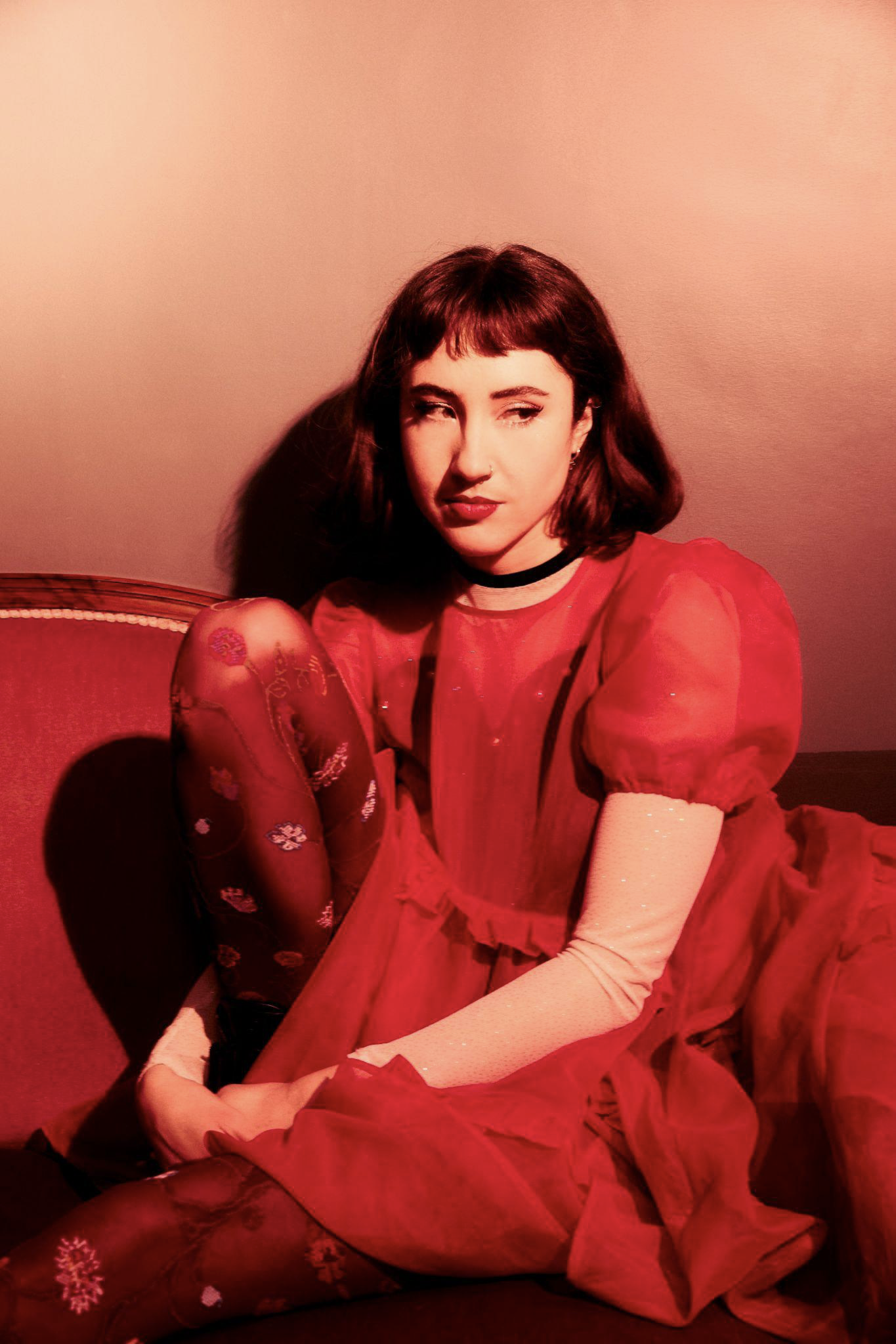
“Everything to do with my life and my relationships all gets fed into it and then comes out in an abstract way. That’s what it is to be a good artist, it’s to take it all in and then have it just naturally come out in a way that ties everything together.”
Formed in 2013, the British pop duo from Norwich, Let’s Eat Grandma, describe themselves as “psychedelic sludge-pop”. The Jenny Hollingworth-Rosa Walton duo first made a successful entrance onto the music scene with their debut album ‘I, Gemini’, gaining many favourable reviews for the dark, satisfying, strange and compulsive nature of the record.
In 2022, the duo released their album, ‘Two Ribbons’, saturated with grief and turmoil. Finishing a project that consumed much of their lives, Hollingworth and Walton both decided to step back and find space to breathe, carving out this new space through their personal projects and solo adventures. And thus, in January of 2026, Hollingworth (Jenny on Holiday) released her solo debut album, ‘Quicksand Heart’.
Conversely, Rosa Walton’s solo career initially launched in 2022 with the track ‘I Really Want to Stay at Your House’ for the Cyberpunk 2077 video game. It was later featured on the immensely successful Netflix series: Cyberpunk: Edgerunners.
On the 5th of June, Walton made a grand launch with her debut full-length album ‘Tell Me It’s a Dream’ which, as she claims, is the title of her life. Speaking out about this adventure, Walton expresses that she’s not looking for an independent spotlight through this record, instead, ‘Tell Me It’s a Dream’ is fuelled “by the polar opposite spirit – an album that started off purely as extra-curricular catharsis, that’s now taken on a rich new life buoyed hugely by the people and places that have helped will it into existence.”

Initiating the project during lockdown, Walton worked with the producer Sam E Yamaha on many of the album’s first tracks. She then continued re-working the demos, re-writing lyrics and composing new instrumental elements whilst taking on a new direction – higher vocal register, more ethereal ambiance. Walton co-produced the album with David Wrench (recognised for his previous work on Frank Ocean’s discography, FKA Twigs and others) and recorded it with a band of live musicians – guitarist John Victor, bassist Kam Khan and drummer Elena Costa. Walton’s friendship with Jenny Hollingworth is still going strong, the pair continuing to support each other in their relative projects, with Hollingworth lending a vocal feature to ‘Prettier Things’ and Walton appearing as a backing vocalist on ‘Quicksand Heart’.
This collaborative process between herself and the production team has been of crucial importance for Walton, as she says: “The record has really been about this group of people, and one of the key principles of it has been in feeling so supported and having such good fun with them making it. […] It’s all very interwoven – my life and my record and the people that are involved, who are the closest people to me.”
Described as ringing with the audible fizz of friends hanging out and having fun, euphoric, brightly emotional and aiming heavenwards, ‘Tell Me It’s a Dream’ instrumentally feels like a fresh, 2000s rom-com or teen comedy – think 16 Wishes, Freaky Friday etc. It sets the vivid scene of mischievous but sparkling friends figuring out the world as they go, discovering its limitless pleasure, living their lives to the fullest and brimming with spirit despite the trouble they meet along the way.
Walton’s voice, on the other hand, fits nicely with film musicals like Hairspray. I would love to see her voice in animations and musicals, where the higher vocal register would perfectly reflect the lightheartedness of it all. Throughout those vocals, Walton also carries a delicate, fine and soaring tinge adjacent to Kate Bush’s register and the wanderlust elements of Cults. Besides these qualities as the album’s biggest pros, production-wise, ‘Tell Me It’s a Dream’ would occasionally benefit from more analogue-like ambiance, dynamic and warmth to the tracks, similarly done by the band Her’s, for example filtering vocals themselves through reverbs and vocoder effects.
Nonetheless, ‘Tell Me It’s a Dream’ will be another many people’s perfect summer soundtrack, coming out promptly for the (hopefully) sunny season ahead and ready to keep you company during outdoor escapades and frolics in evening city landscapes. During the interview with me, Rosa Walton herself expanded on the creative process, the collaborative process and explained some intrinsic elements that make up this whole new project.
Here’s what she had to say:
RL: In 2022, the Cyberpunk universe featured a song written by you and Hallie Coggins on its soundtrack, and both the show and game achieved massive success and critical acclaim, the song itself racked up 400 million streams and earned you a Gold Disk. What most noticeable change did this success bring into your personal life, if any?
RW: Just to start, Hallie Coggins isn’t a real person, she’s a character. So, I wrote the song by myself! But that’s a common misconception because on Spotify she’s tagged, but she’s not real. Everyone has characters in the game. It’s funny because I did a song for another game afterwards and people were asking me if I’ll do that one with Hallie as well.
I don’t know, it’s quite mad that that happened. I think it’s not something I’ve fully been able to process because it’s not a normal thing to happen to a human, probably. There’s not really any way of computing it, but obviously, yeah. It’s really cool.
It’s almost like it’s not in my personal life, it’s separate, which means it’s me but a different version. I guess it’s almost not something that I can really even think about.
RL: In 2022, you also released the album ‘Two Ribbons’ through Let’s Eat Grandma, which was very saturated with grief and emotional turmoil. ‘Tell Me It’s a Dream’ takes the opposite emotions and is completely unapologetically ambitious and happy. Do you think there’s been an emotional journey for you, that’s informed this upcoming record and its emotional charge?
RW: I wouldn’t say ‘Tell Me It’s A Dream’ is completely happy. There’s two sides to it, and it’s happiness that has come out of complicated times. The outlook of it is happy and inspiring but that’s come from complicated places.
RL: Do you feel there’s any tangible difference between being a solo artist, and being in a duo, especially during the creative process?
RW: Yeah! I guess this project has also meant that I’ve collaborated with other people in a different way. The band that I worked with, we tracked it all live all together. Two of the musicians I’ve worked with before and they’re all good friends of mine and David [Wrench] who also produced it, I’m close friends with. I guess being able to have more people, having their involvement too. Even though it’s a solo project, and the core of it comes from me and is guided by me, the point of it was never ‘I want to do everything by myself’, it’s actually the opposite in a way and it’s opened up more collaboration and being able to rely on a variety of other people’s opinions and advice.
When me and Jenny were starting out, we had to prove that we could do everything ourselves, particularly as young girls. We started the band at 13, and got signed at 16, and we played all the instruments on the records ourselves, and played them live and that’s great but also, it’s good to work with a band of musicians who are very technically competent and good at their instruments. That’s a whole other craft in itself. To be able to do that without feeling that I have to prove that I can attempt to play a bass guitar is nice.
RL: On the other side, then, what’s been the most challenging aspect of creating this record as a solo artist?
RW: That’s a good question, probably just the vulnerability of not having a bandmate to hide behind. Not in the realm of the studio and with the writing, but it’s more just like when it comes to… times that I’m the only person. Like an interview, for example! That’s what comes to mind! It’s a more vulnerable position to be in, that it’s all down to me and I have to speak about my projects. But I am also capable of doing it, and I do have a lot to say about it!
RL: And you have mentioned Jenny previously with me, and when it comes to this upcoming album, what element do you think she brought into this album, without which it wouldn’t be the same record?
RW: I wanted Jenny to sing a feature in ‘Prettier Things’, and she brought a lot to that song. She comes in on the second verse and her voice has a style that is like nothing else, she’s just become stronger and stronger as a vocalist over the years. I guess the way that she can capture that distilled emotion in her voice in a very strong and powerful way, that brought something very different to what I can do with my vocals.
It’s also quite special having her as a sort of answer-phrase to what I’m saying in that track, there’s always been something about mine and Jenny’s voices together and it’s partly because we’re best friends that they work so well. That’s what that is about, it’s about me and her being like dragonflies in a magical garden that we’ve discovered, that only we can access. That’s also what happens with our vocals weaving together.
RL: You’ve talked about this album being the title of your life, and about your friends and people you work with having been massive muses in its writing process. We also hear that as people, we’re mosaics of everything we’ve ever loved. Do you think that this album in particular is perhaps a mosaic of things you love, and things that represent you the most?
RW: Totally, yeah! It’s a really nice phrase about the mosaic, I’ve never heard that before. The one that I’ve heard is that we’re a combination of six people we spend the most of our time with. But I like the mosaic one better.
Having all of those people as a support and muses as well, I’m writing about my life but it’s also about people around me. As a songwriter, over the years, I’ve been able to branch out more with what I’m doing naturally, in a way. I don’t know how to describe it, but it’s almost like everything to do with my life and my relationships all gets fed into it and then comes out in an abstract way. That’s what it is to be a good artist, it’s to take it all in and then have it just naturally come out in a way that ties everything together.
The people that I’m close to have been an important part of that and what this album is.
RL: And which song, in specific, is the most reflective and intimate for you from this record?
RW: I don’t know… they kind of all are in different ways.
I guess ‘Halfway Round The World’ is pretty reflective and intimate. I feel like that captured a very special feeling or moment in time really well. That song is personal for me but also I always feel like it would capture that feeling and put it into a song that could be a universal love song, and people could have their own meanings attached to that. It captures a time when I’m saying ‘how long can this last?’, and it lasted in a song.
RW: You began writing the record during lockdown, and since then have re-written and re-recorded many parts. Which song has changed the most since it was first written?
RW: Good question. Well, the biggest changes that I made were putting a lot of the synth parts onto the guitar. Songs like ‘Prettier Things’ or ‘Heart To Heartbreak’ were both completely on synths and with ‘Prettier Things’ for example, the rhythm of the guitar is unusual because it was originally on a rhythmic synth. I think it was very satisfying when that synth worked even better as a guitar part, it’s more cohesive than having individual synths. I always wanted that part to sound like dragonfly wings.
John played the guitar on the record, and he played that rhythm so perfectly. He’s such an amazing guitarist, and when I said I want it to sound like dragonflies, he got it spot on, even the shiny guitar tone and the fluttery nature of it.
RL: So which song has remained the closest to what it was originally written as?
RW: ‘Sorry Anyway’ is pretty much exactly the same. Instrumentally, it is exactly the same. The only thing that I re-wrote is the lyrics for some of the verses. That’s because I had the main chorus lyrics but with the verses, I mumbled nonsense in the demo and had to come up with the lyrics. That was a song that was really hard to get the tone right, because it’s tongue and cheek and it’s also about being annoyed at someone, but not being bitter. I never like putting bitterness in a song, not that I can’t be bitter as a person, I just think it’s not a very nice thing to hear in a song. Some negative emotions work well, but not that. It was quite hard getting that so I spent a lot of time on those lyrics, getting that tone right. In the end, it was kind of the fun ones that seemed to hit in the right way. For example, the lyrics like “You got me a book, but I’m not gonna read it, you don’t have to read to be clever” – ones like that are pointed but at the same time, it’s fun.
RL: When you work with lyrics so much like that, do you find yourself having any favourite ones that you write? Whether they came up during the writing process or post-production, maybe?
RW: I love that question. I like the one in ‘Wave Machine’, in the chorus which is “You take me to now or never” – that whole chorus, when I wrote the song and that chorus I’d just been swimming and I was really into swimming at that time, getting that buzzy feeling afterwards. That’s when I wrote that, and usually with good lyrics I don’t usually sit down and think ‘what’s this gonna be?’ – I just sing what comes out naturally and that’s where my best songs come from. I like that those lyrics don’t technically make grammatical sense, but they do in that I was picturing the ‘now or never’ as a place in the sky, above the waves, like you’re pushing up into it. Calling it a place, ‘a lot like heaven’.
The lyrics about the days of the week at the end of that song as well – they capture that I don’t know how I am and how life can be, how my moods will shift from day to day, feeling confused and constantly changing. It just summed up my experience well, that’s probably the song I’m most proud of.
RL: When people listen to this album, what’s the one thing – a feeling, maybe even a lesson – that you want them to take away from it?
RW: I guess I just wanted it to be inspiring for people to not be held back in life and not be afraid of doing what they want to do, in a variety of different ways, just to believe that they can do what they want to do. That’s a lyric in ‘Romance Is Dead’ – “you can do whatever you want”.
RL: I have noticed quite the trend recently amongst musicians, that a lot of the music they release focuses on similar sentiments.
RW: Interesting! I guess there’s just a lot about the world at the moment which is really devastating. So, music is one of the few things that can be joyful, pure. It’s like, why not make that really good?
RL: In this month of June, you’re embarking on an in-store tour. Do you prefer playing big venues, or to small and intimate audiences?
RW: I guess it’s easier to compute individual people at the smaller shows. I’m really looking forward to the London one, because my friends and family will all be there and that is what I enjoy more than playing to a big crowd. I think it’s more meaningful to me. I’m really looking forward to these shows, especially to start off the project with.
RL: I really like asking this question and since you’ve brought up family and friends, do you feel like performing for people you’re close to because it can be too intimate almost, or maybe it’s more nerve-wracking when it’s strangers because there’s more potential judgement?
RW: I used to prefer it when it was strangers, however that’s changed! I think performing with my friends and family is more special because it shows them what I’ve been doing these last few years. To have them enjoy my music or be proud of me is one of the loveliest feelings, really.
For my release day, that’s what I want to be doing – I want to celebrate it with the people I care about and it’s nice that they’re all coming to see me do that. That’s easier for me to compute as well, than strangers who I don’t know. Obviously strangers should still come to my show, just to be clear! But yeah, there’s something extra special about having my friends and family there.
RL: What’s your favourite concert you’ve played so far in your career?
RW: I have to think of the right answer… There’s been lots of special ones in different ways! It depends what type of special. I could say one like Fuji Rock in Japan or also when we’ve played at the Norwich Arts Centre. They’re different types of special, so I don’t really know but those are two that could answer that.
RL: What’s the most enjoyable part of touring for you?
RW: I just love how ridiculous everything is on tour. You spend a lot of time in the van, and I’m very sociable and being around people all the time, so I’ve got the perfect personality for being on tour. It’s also kind of exhausting, so it’s hard to explain. It’s almost when you’re delirious and everything is funny and surreal – it’s a bit ‘tell me it’s a dream’!
Looking back at the 13 year old Rosa when she first started making music, what piece of advice would you give her? And what piece of advice do you think she would give you?
RW: That’s an interesting question as well! I think when me and Jenny started the band at 13, we had very fearless attitudes, which I still kind of have but in a different way. We just did not care what anybody thought at all.
I guess, when we started writing songs we didn’t know how to technically write a good song. I remember reading a book and it being about how to structure a pop song – it was verse, chorus, verse, chorus, bridge, chorus with an instrumental somewhere in there. A lot of our songs back then ended up being free-flowing with a lot of sections put together. My advice from my 13-year-old-self to me would be to not get caught up in the rules now that you know them.
And then, to me at 13 years old is hard because I don’t even remember what I was like, and I don’t have any regrets! I probably would just tell myself to watch out because it will be a rocky road but you don’t want to hear that, so maybe I wouldn’t say anything at all except just tell her to keep doing what she’s already doing.
RL: You said: “I think a lot of the attitude in the songs is about being ambitious in life and following your dreams. And so that’s what I intend to do.” What’s the next dream that you want to follow? Do you intend to keep making solo albums?
RW: I’m a very ‘in the moment’ person with what I’m doing, so right now, I’m doing what my dream is, which is playing the shows this week and releasing my record. I just want to enjoy what I’m doing, but I’m constantly writing songs and I’ve got loads I want to release in the future, so I don’t feel like I’m thinking that I need to make the next thing now because I’ve got a backlog of songs anyway.
I’m just enjoying the other side which is performing and putting everything into that, and that’s one of the reasons I wrote the songs, it’s to play them live.
RL: Which song do you think you’re most excited to play live during the upcoming shows?
RW: I really like playing ‘Romance Is Dead On’, that’s the song that I feel I connect with the most right now. It’s really fun and I get to do my guitar solo which I enjoy.
RL: And for a finale – would you like to leave a quick message for the readers?
RW: I don’t know! Maybe a quote from ‘Romance Is Dead On’ – “Sometimes, baby, we live and we learn, sometimes we just live”! That’s my piece of advice.
Of course, fans of Let’s Eat Grandma, but also listeners of Beabadoobee, The Cranberries, CHVRCHES, the French indie band La Belle Vie, or Cults will find themselves at home with Rosa Walton’s new, solo album, available on streaming platforms now.
Article by Rozalia Lewandowska


