
“Expect nothing and follow your heart”
Ton Scherpenzeel, is a Dutch composer and lyricist, as well as a founding member of the band, Kayak. During his 48 years in the music industry, he’s also worked with the UK band, Camel, as the keyboardist, and another Dutch rock, disco and pop band, Earth and Fire.
Ton’s work doesn’t just end with prog-rock, pop and disco bands, however. In the past, he’s composed various musical productions both for theatre and film, including a score for the Dutch film ‘Spetters’, directed by Paul Verhoeven. His theatre scores range from ‘Robin Hood’, to ‘Peter Pan’, ‘Alice in Wonderland’ and ‘Jungle Book’.
Ton’s first own album was released in 1978, an adaptation of ‘Le Cavarnal des Animaux’ by a French composer, which was then followed by his album in 1984 -‘Heart of the Universe’. His 2021 album,‘Velvet Armour’ was inspired by the the essence of the Medieval and Renaissance era, with a blend of Baroque folk and progressive rock ballads – a record I could easily see featured on ‘The Witcher’ soundtrack.
This album was also Ton’s initiation into OOB Records (founded by Kathy Keller), which is celebrating its 10th year anniversary this very year. Unsure about ‘Velvet Armour’ commercial success, Kathy Keller was the label to approach him with a proposition to release the record as a complete album rather than demos. It was a fruitful proposition at that, since the album was later longlisted for Best Album, its second track (‘River to the Sea’) also longlisted for the Celtcast Fantasy Awards.
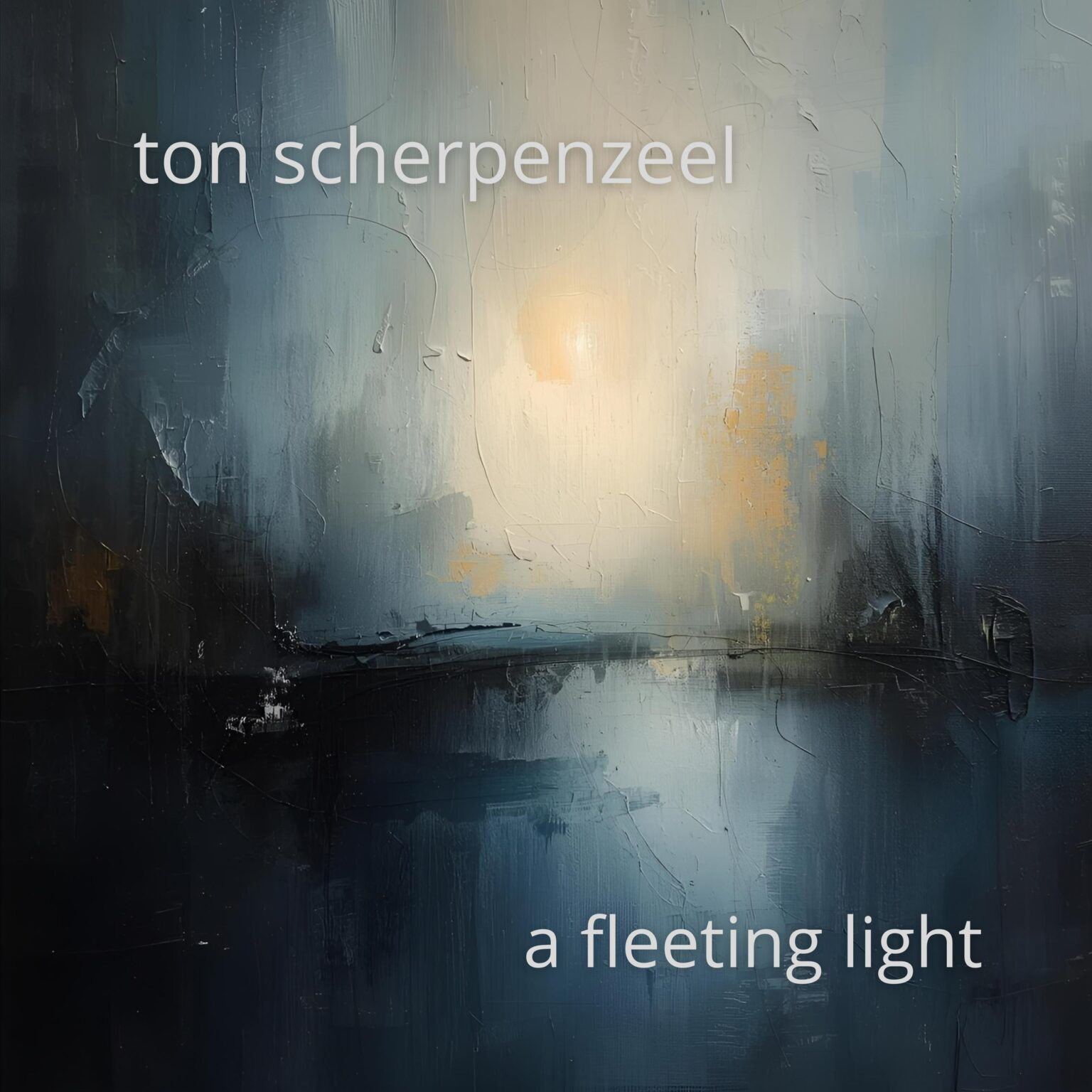
This year, Ton Scherpenzeel is making a return with his album, ‘A Fleeting Light’. Uniquely available on CD only, the only track to be released digitally and on few streaming services is ‘Chasing The Wind’ (Chasing The Wind | Ton Scherpenzeel). But, the album’s uniqueness goes beyond its listening format – ‘A Fleeting Light’ is Ton’s first and only fully instrumental record. It includes two tracks thatare entirely improvised, the remaining tracks are Kayak’s previously released tracks, now stripped-down into piano ballads.
Played solely on the piano,“no overdubs, vocals, guitar, bass, or drums”, the record is intended for “focused, seated listening with eyes closed to encourage an immersive, imagined landscape” and encouraging you to “to enter this imaginary peaceful place”. The entire record runs for roughly 48 minutes, 38 of which are just the first and title track. The CD is packaged within a gorgeous 4-panel digisleeve, featuring a surreal painting that immerses you in its peaceful and relaxed atmosphere.
Recently, I had the opportunity to ask Ton a few questions regarding his work and ‘A Fleeting Light’. Read ahead to find out what he had to say about this new and exciting project. And more!
RL: Before I ask about the album, I’d like to know more about your previous work. You’ve been a member of bands such as Kayak, Earth and Fire as well as Camel. What’s the one most important lesson you’ve learnt whilst working in the music industry?
Ton: Expect nothing and follow your heart. The first is hard when you start- music business is full of promises and everything seems possible when you’re young and eager to ‘conquer’ the world. The latter can be hard when you grow older, have financial obligations and therefore feel forced to make compromises. Both are easier said than done, but they are well worth remembering.
RL: You’ve also worked with theatres and films. What was your favourite thing about composing for film and theatre productions?
Ton: Especially in theatre productions I usually had much freedom to do what I wanted and explore my creativity. The only thing that mattered was: does it work in the show. And I have been lucky to work with people that allowed me that freedom and who appreciated my music, my style and my work ethics. If it doesn’t work: kill your darlings. (The good news: I could always use it another time, in another form or production. Few good ideas are lost forever). I became much more diverse with my music, these theatre productions really broadened my musical horizon. I’ve done less in films, and my experience in that field has also been a bit different. There was a less personal approach and the director could basically do anything he likes with the music in the editing room. I can appreciate that, and it’s still a great opportunity to compose, but it’s just been a little less enjoyable for me.
RL: In 2021, you released the album ‘Velvet Armour’. It’s been described as an album that “reflects the essence of the Medieval and Renaissance era, with a blend of Baroque folk and progressive rock ballads.” What other historical periods or stories would you love to represent in your future compositions?
Ton: These folky baroque medieval renaissance tunes come quite natural to me, without being too strict in regards to form or style. It was always my personal interpretation of it, very intuitive. I am not a purist, and I don’t have the theoretical knowledge to be so either. I have incorporated different styles in Kayak’s rock operas Merlin, Nostradamus and Cleopatra. I used elements of the period in which the story is told, with no other intention than making it work without losing my own or the band’s identity. In the theatre productions that I wrote the music for, the stories would sometimes belocated in Spain, Africa, or the Balkan, or wherever. That was challenging, and surely I used musical quotes, but I always did my best to stay true to myself and avoid being corny or predictable. As a composer, the period between 1500-1700 appeals to me the most. For my next album I am sort of looking to combine the style of my solo album Heart of the Universe and my latest Velvet Armour or The Lion’s Dream.
RL: If you had to choose just one thing that inspires you the most often to compose music, what thing would that be?
Ton: I am not sure what you mean. Thing? There is the unstoppable desire, the drive to create something new and to become better at what I am. Maybe it’s the idea that people can be touched by something I write, which is inspirational enough to me.
RL: What’s been the one most important project you’ve completed during your career?
Ton: If you could call Kayak a project, that is probably it. These eighteen albums sort of defined and established my career and my name, although there were of course many band members involved. Which means I always had to find a middle ground between my strength as a composer and lyricist, and what would fit the band and how to get the most out of everyone’s capabilities, especially the vocalists. Around 2021 I felt I couldn’t bring myself anymore to do everything that was needed to continue with the band like touring and the struggle that comes with keeping a band going, and try to make better albums than we already did within the Kayak concept. At that moment I could only conclude it was over, and I needed to take another path. Wherever that would lead me, with or without the name Kayak.
RL: So then, you recently released your newest album, ‘A Fleeting Light’. What does the title of the record represent for you?
Ton: It represents the fleeting light of inspiration, which is like breathing air for people like me. Here today, gone tomorrow (or even here one minute, gone the next). You never know if it will come, how it will manifest itself, if it’s worth keeping- and when it’s there it can easily escape you. Grab it while you can.
RL: Two of the tracks on the record are completely improvised. What inspired you to include improvised tracks?
Ton: Improvising has always been the start of my compositions. I thought it would be a nice idea to share that part of the creating process which people never hear.The improvisation is the baby, maybe imperfect but with the promise of life in which anything is still possible. The song is the grown up, adult version of that baby. The final person or shape it has become, like it or not.
RL: At any point were you worried that, because of the improvisation element, you risk making mistakes and having to re-record the tracks?
Ton: If I were afraid of making mistakes, I wouldn’t have recorded anything ever, or played live. Of course I don’t want to make them, and as a musician- depending on the gravity of the mistake- I feel a bit silly when I do, but my musical life has been full of mistakes. Nothing special about that. And as for the long title track: these were really four sections of like ten minutes average each, that fitted well together (I would typically start where the last one ended) and made one long musical journey. Remember, these are improvisations, not structured songs. I could not re-record the tracks, the new one would always be totally different. It was just a matter of: how long can I keep on going and still play surprising or interesting stuff. If I felt it was enough, or a mistake came along, I simply stopped.
RL: Do you find more authenticity when taking the time to compose music and refine it, or to improvise it?
Ton: Not really. I think I am being authentic in both forms. I can only be me, with my musical soul and limitations. Whenever I tried to be ‘someone else’ in the past, musically, it never really worked out. Though having said that – even then, I am authentic in my trying and failing.
RL: The remaining three titles are stripped-down versions of previously released Kayak instrumentals. What was the process of re-composing these songs and was it difficult having to turn prog-rock into classical pieces?
Ton: I did not re-compose them. This is how they were written and sounded in the first place, before being arranged for the band, and that’s what might make them interesting for people that only know the full versions. I also don’t really consider these pieces prog rock- whatever that may be. They’re pretty compact pieces, have a clear structure, melody and chord progression, no improvisations or solos and hardly any time changes. That’s not really the definition of prog rock. And by the way, never understood how you can play the same songs for fourty years or more and still call it prog rock.If it was progressive decades ago, it simply can’t be that now. But I never really cared for these labels in music. Which may be the reason Kayak is often misunderstood and falls in between all sorts of categories.
RL: The record specifies having featured only piano solos -“no overdubs, vocals, guitar, bass, or drums.” Why was it important that this album is piano solos only?
Ton: Yes, because I go back to the source- me on piano. That was the whole idea, that’s how I wrote 99% of my music. Arrangements can enhance it, or mask the weaker parts if you like. But the essence is those black and white keys and me trying to create something that wasn’t there before. Complex arrangements are great, but can be much harder and tiresome to absorb. Only piano is vulnerable,and never overwhelming. The listener has much more freedom to interpret.
RL: The album is described as “intended for focused, seated listening with eyes closed to encourage an immersive, imagined landscape. ”The cover artwork also features a surreal painting. When you were recording ‘A Fleeting Light’, and when you listen back to it – is this the landscape you imagine?
Ton: That landscape can be different for everybody, I think. The cover art represents the concept of the album of hard-to-catch inspiration rather than a landscape I might visualize while playing. I find it hard to listen back to my own stuff and not analyze it and think: maybe I should have taken another path, or another turn. But I do not imagine a landscape and then try to visualize it with music. It’s rather the other way round. While playing, I am merely busy finding the right notes, not looking at a landscape. The landscape is visual but at the same time, a metaphor. And especially with instrumental music, it’s easier to be taken to a land that needs no language other than the twelve notes of our musical scale.
RL: Which comes first – does visual artwork inspire musical compositions, or is it the music that usually conjures up vivid imagery for you?
Ton: The music can do that, indeed. Pretty abstract images, though. I couldn’t say that seeing a painting ever inspired me to make certain music. Maybe it did, but I can’t recall it.
RL: And, because the album is intended for focused listening and an immersive experience, do you find that there is a therapeutic, healing element to music?
Ton: I would certainly hope so but it wasn’t exactly my intention. The idea of doing this came spontaneously. I just hope that it touches the hearts of people and that way I can add a little bit of healing or a bit of joy, or whatever. With this album, sure, but that has always been so since I began writing and playing. Music is communication, and therefore needs a sender and a receiver. And then hopefully the receiver is on the same wavelength. If not, it means nothing, other than my personal pleasure in playing it.
RL: Which track from ‘A Fleeting Light’ is the most meaningful to you?
Ton: Hard to choose, but maybe Chasing The Wind is. Basically that’s the title track in a condensed form, which for me makes it easier to listen to as a whole, and that represents the general idea pretty well. The other three have a history of their own. Two with Kayak and Ayre is from my solo album The Lion’s Dream. As a composition, Ayre is my personal favorite.
RL: What’s the one message you’d like the listeners to take away from this album?
Ton: I don’t think or deal in messages, but in feelings and passion. The unspoken. It is communication on another level, one I don’t understand myself. Isn’t that great? It’s like lyrics to the songs I write: people often ask me, what do you mean with this or that. Sometimes I can’t really explain it myself, though I am sure there is always a layer in them that makes sense, that there was a reason why I wrote what I wrote. But I believe that what people read in it (or hear, in A Fleeting Light’s case) is more important than what I meant. Sometimes I am really surprised to find out the way people respond to a certain song. That’s the intangible, fascinating and sometimes frustrating side of making music. You never know.
RL: Will you be announcing a tour or any live performances of this album anytime soon? If so, what are you most looking forward to?
Ton: No, I don’t plan to tour anymore. I have done that for 50 years or so, and it is taking up too much time, energy and space in my life right now. I do solo albums, but am not a real solo performing artist. Never have been. Always been in a band, or behind the scenes. And I could never reproduce these improvisations, because of their very nature. What if I have an off night when that fleeting light doesn’t show up? Send people back home, saying: sorry folks, not tonight. Better luck next time. And that can happen. Silly example: I could have a tooth ache that night, or got stuck in a traffic jam before the show, and still play an existing song reasonably well. But I don’t think I could improvise being in a state like that. And I don’t want to fall into the trap of repeating myself just because of the lack of inspiration. I’d rather spend my time creating something new.
RL: ‘A Fleeting Light’ is released on CD only. What is your stance on streaming platforms and the‘digitalisation’ of music?
Ton: Difficult. As a consumer I like these platforms. You can discover music, and find what you are looking for. As an artist, I long back for the time of vinyl and CDs. Music, the business, it has all become so volatile. The solidness of a physical representation of your work is important, it feels like a landmark in your life- as a maker, but also as a fan, I think. Digital can always be replaced, changed, even deleted. Then you’re left with just a file on your computer. Well, it does display some of the shallowness of modern life. Everything is available, instantly, everywhere, and because of that, its value decreases. The analogue business was far from ideal, but at least it represented something irreplaceable. Record fairs are there for a reason. But there’s no way back. History shows there never is, times are always changing, whether you like it or not. Music consumption will remain I guess, but it will change shape and take on different forms. I can’t change that. Trying to adapt, maybe, trying to make the best of it. That’s all. But as long as people want to listen, I will make new music, digitally or analogue. We’re not releasing A Fleeting Light streaming for now, because I want the physical CD to sell, simple as that. But maybe some time in the future, when we’re out of stock and decide not to reprint, I suppose we’ll go digital with this one. I mean, we don’t really need to keep it hidden, do we?
RL: If you could leave any message for the younger generations of up-and-coming artists, what would it be?
Ton: First answer, full circle: Expect nothing and follow your heart – oh, and yes, not unimportantly: watch your wallet.
Afterword:
Ton Scherpenzeel’s new album can be purchased directly through the OOB Records website using this link: TON SCHERPENZEEL: A FLEETING LIGHT – OOB Records.
For classical music fans, it’ll be a true gem to possess an album on your shelf that has neither been done before, nor can ever be replicated in the future. Hopefully, as per Ton’s hopes, the album can take you to another world and invoke a truly poignant experience.Sources:
Sources:
Chasing The Wind | Ton Scherpenzeel
Ton Scherpenzeel – OOB Records
Article & Interview by Rozalia Lewandowska


