
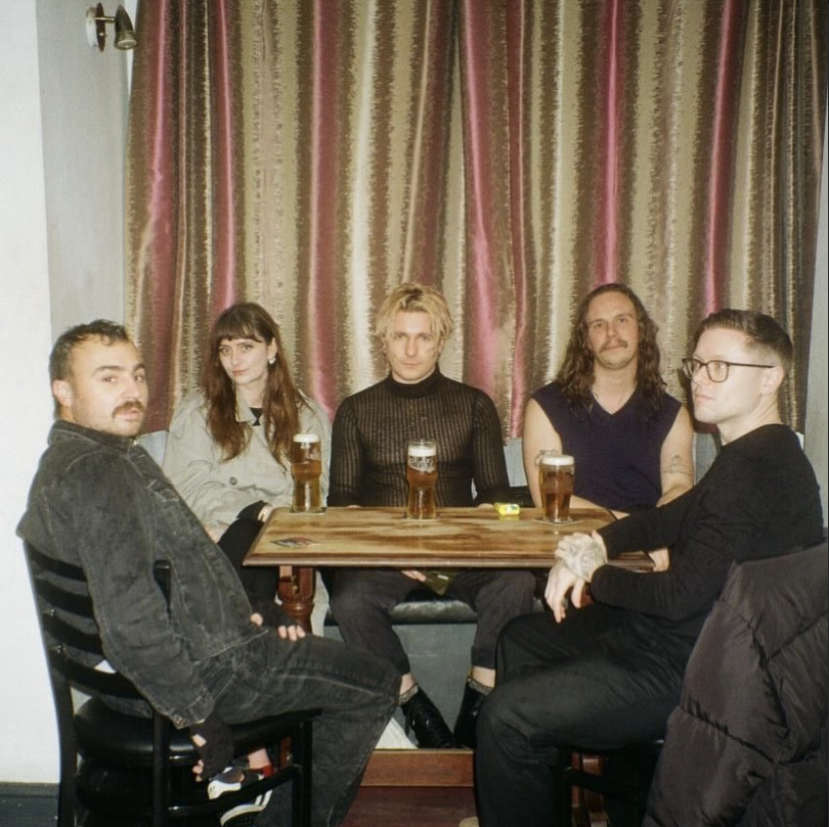
“We should all feel grateful for experiencing tenderness in our life and sometimes that manifests in heartbreak. Heartbreak, desire – this is all something that we can all hopefully relate to.”
In February of this year, I saw one of my favourite performances of all time. The Deaf Institute hosted a gorgeous evening of the five-piece Mancunian band, Marie Franc.
If you haven’t had the chance to read the previous article about their performance and most recent single, here’s the link to read it: Marie Franc with New Release and Live @ The Deaf Institute
And just recently, I sat down with two of the members of Marie Franc – Trav, the guitarist, and Rachel, the lead singer and songwriter – for an interview, asking them about their experiences as performers, growing artists and beautiful writers and composers.
Opening a new chapter with Fabric, the Marie Franc group seems to be taking on a new course – now having carved out their identity song by song, these carefully-weaved elements will interlace with one another in their upcoming music, progressively treading the waters of delicacy and exhilaration.
On the 1st of May, we’ll be able to hear another exciting single from Marie Franc, titled Pendle Hill. As Rachel writes on the band’s Instagram page, teasing the music video: “The song began as a retelling of the Pendle Witches. Historically, ‘witch’ was a label to punish women and outsiders who didn’t conform, those deemed too visible, too free, too difficult to control. As I was writing Pendle Hill, it became impossible not to channel the women around me who face that same persecution today – trans women and queer women, and the political witch hunt against them. The song is a celebration of their strength and resistance, and reframes the witch as a figure to represent their survival”.
Both members were incredibly authentic, intriguing and open to the conversation, constantly leaving me itching for more questions and answers, and I could not be happier to now present this interview to you, the reader, revealing some more secrets behind the Marie Franc lore.
Always magical, always consuming, always macabre and equally feathery, here’s Marie Franc:
RL: I was lucky enough to see you perform at The Deaf Institute in February and both the ambience and performance were wonderful. What was the experience like putting on a show over there from the perspective of an artist and singer?
MF: This time, on stage, it was very practically different for us because it was the first time that we were using in-ear monitors. We recently transitioned onto in-ears, so the live experience was completely different to our usual, standard performance. It meant that transitions were potentially a bit slower.
One of the things with wearing in-ears is that it takes you out of the room a little bit, but then the room was so full of people that we love and so many fans and friends. A guy had travelled all the way from London, Chris, to come and see us! He’s a big fan and we posted him a t-shirt.
So it was an amazing experience, we love playing live, it’s kind of what I think we’re best at. Our songs really carry themselves live.
RL: You also spoke to another interviewer about the band having been formed in an ex-cotton mill. Would you ever consider coming back to those roots in live performances? (eg. like Leucotome)
MF: For sure! The cotton mill is Brunswick Mill and that’s our studio! We’re there twice a week. Within that mill there’s probably about 20 permanent bands, and lots of different musicians that kind of float through. We’re actually subletting our studio out to a band from Brighton this weekend.
[Trav]: It gets very cold there.
[Rachel]: It does, and there’s rats! But we do love you Brunswick Mill! We do actually love it, it’s a genuine feel of community there. We have a big group chat, which I think anyone can join, so if any musicians are reading this, you can join the group chat and in there people post instruments, gigs, music they’re bringing out etc.!
RL: What performance throughout your music career has been the most memorable?
MF: [Trav]: New Century Hall. Every part of that, from my perspective, was fantastic. The sound was great and being on a stage like that, it was probably the biggest stage we’d played, and it felt incredible.
[Rachel]: I loved our first headline gig at The Grayston Unity, I’m a big fan of that venue and of the people that run it. It’s in Halifax, and we’ve played there three times now. The owners are amazing, the bar staff and Tom, who works on sound, is now our travelling sound guy, as well. We basically stole him from the venue to come and work with us! He’s just the kindest sound guy in the world! Best sound guy we’ve ever had.
[Trav]: It was probably the first time we played in Halifax, too.
[Rachel]: We actually played our first ever gig on the 31st of October in 2024. So we’ve only been gigging for about a year and a half… not even two years yet. Everyone thinks that we’ve been doing this longer and we’re like ‘Haha! No, this is only our, like, 20th gig!’. But I think it’s just practice and a bit of self-confidence goes a long way.
RL: I want to take a look at some of your past music. Warthog has some of the most ethereal and beautiful but haunting ambiance. The lyrics are so poetic especially with the juxtaposition of softness of the person breaking a heart, and the action itself being so violent and gory. How do you find fitting imagery that can carry your emotional weight?
MF: Warthog is really weird, and I wrote it pre-lockdown, working with a producer called Conor Lawrence. We did Warthog, Beatrice and Petal which we’ve since removed from Spotify. Before I had a band, none of it was mixed and I just dumped a lot of music on Spotify.
But lyrically, I’m kind of a visual writer and I wrote that song in one evening. I just got into the studio and something had happened in my life that I found extremely inspiring so I just sat down and the lyrics came out of me. And that was one of the first times that that had happened, it was almost a flow state with this song, just writing the lyrics and they were making so much sense to me. It was really strange but I love visual imagery, the tearing heart and meat – it is quite violent, gory imagery, as you say, but I like to balance that with the softness of nature.
RL: It’s been a short while since the release of Fabric. How does it feel to achieve such great numbers as an indie band, completely organically and without major labels and sponsorships?
MF: It feels awesome because we don’t have any money behind us, we are completely self-funded. We don’t have a PR team, we don’t have playlisting – all of those numbers we achieved are solely from people who want to listen to us, which is really, really cool.
Especially with a song like Fabric which is quite anthemic and epic, we didn’t know how it would land against our other songs, but it just slots in so nicely, because the next EP will be this anthemic, epic-y music.
[Trav]: It’s a good start of what’s to come.
RL: Would you ever consider signing up with a major label, or would you rather stay local and mostly independent?
MF: Never say never for us! Personally, I like to keep my music in the city and in the North, since I’m very fiercely from the North West and everyone that we work with including our agent, our mill, so I kind of want to keep our music here, because I do think that Manchester’s music scene is incredible. Ideally, we’d sign somewhere local.
[Trav]: It could also depend on what would be in the contract.
[Rachel]: There’s lots of amazing labels in Manchester, like Heist or Hit, they’ve got Westside Cowboy and Georgian and a couple of other people on there. That, to me, would be an incredible indie label that I’d love to sign with. Or Melodic Records, they’ve got WH Lung who I love. Never say never, but local is probably more suited for us.
RL: Fabric is a song about coming out into the light, about self-reflection and self-loathing. Is songwriting and making music a kind of cathartic experience for you, to let go of emotions that don’t serve you anymore?
MF: I would say so, lyrically anyway. It’s one of those things that sometimes I’ll be writing lyrics to a song and realise that that’s what it was about. The dots kind of join up, but sometimes it is about nothing in a way. Maybe I shouldn’t say that but sometimes it is just because the words flow together and it feels nice. There is always a level of emotion that comes with a Marie Franc song, because I am an extremely emotional young woman! If I was a Victorian woman they’d probably send me to the ocean with hysteria.
RL: Since you began making music, which other song do you feel has been the most open and authentic about yourself? Is there one song that particularly invites the listener into your world, making it an exceptionally intimate track?
MF: So Warthog, Beatrice, Leave The Light On are incredibly intimate lyrically, Fabric as well. All the slower songs generally probably have the most emotions attached. I’d say all of them quite frankly, we’re like an onion with layers, to quote Shrek!
[Trav]: The first layer just happens to be very emotional! Then the rest is even more depending on the timing of the song. And we are really fun people, but Rachel comes out with these beautiful lyrics and I’m like, ‘bloody hell, where’s that come from.’ But we roll with it and it works, and it’s fantastic.
RL: Is there any song from your discography that you look back on and wish you could change or re-write?
MF: Oh, Dirty Hands! I wrote that song when I was 19 so, to me, it feels immature now in comparison to now as a woman. But everyone loves that song!
RL: A lot of your songs revolve around intimate themes of love, sexuality, longing and desire. Does it ever feel intimidating having to perform that in front of crowds, or does it make you feel more human when you see other people relate?
MF: It makes me feel more human because all of those emotions are an extreme thing. They’re human experiences that we all have. My friend is currently going through a bit of a heartbreak and we should all feel grateful for experiencing tenderness in our life and sometimes that manifests in heartbreak. Heartbreak, desire – this is all something that we can all hopefully relate to. I don’t feel intimated, sometimes when I sing more ‘dirty’ lyrics because my parents might be in the audience, but other than that, no!
RL: Your music and identity oscillates heavily around Mancunian lifestyle and its soundscapes. Are there any inspirations you draw from other parts of the world and their music?
MF: Yes. We get this question a lot, and what’s really interesting about our band is that we each have very different musical tastes. Trav is obsessed with Queens of the Stone Age, and more heavy rock, my personal influences have been Joanna Newson, Leonard Cohen – these really poetic, folk artists. That’s some people I’ve always drawn on all over the world.
Reading, as well, throughout the years has informed me. Beatrice is about Dante’s Inferno. Beatrice dies and Dante is desperate to find her, and he will go through the depths of infernos and hell to do that. Literature is a big source of inspiration, too.
RL: You’ve been teasing your upcoming release of Pendle Hill that speaks about the witch hunt against queer people globally. What does this new and upcoming track represent for you personally, and what encouraged you to write this piece that stands up for minority communities?
MF: Of course, so, the Lancashire witches and witches in general are stories I’ve resonated with. I have a tattoo on my arm of the word ‘Witch’ that my friend gave me! I’ve always had this obsession with the macabre and folklore, so I found the Lancashire witches because of being so close to it and it’s really interesting as a story. In Manchester we do have this huge community of LGBTQ+ people and I’m really lucky that lots of my friends identify with those communities, and are trans. I was writing about witches, initially thinking about it from a very heterosexual, woman’s stance. In some ways I have to tread very carefully because it’s not a lived experience for me but I am aware of the political witch hunt against people like my friends. Violence against women has always been a very prevalent and huge problem, so I hope we can move towards a future where that isn’t a thing.
My friends are so incredibly supportive, in the video they all understood the vision. I didn’t want it to seem like I’m wheeling friends out, but my friends are also into folk-horror, so honestly, it was such a fun day! We did it during Storm Dave and it was absolutely freewing but we had such joy doing it. To spend a day with my friends, prancing around like witches was really fun!
RL: The music video forebodes a very eerie, dark and moody atmosphere. Does the visual element come to you immediately when writing a song, or is it usually an element that takes time to flourish?
MF: I think that the visuals that come with the music, like Loungewear, always comes and just appears in my brain! I think it definitely is that once the song is written, that informs the story we’re trying to tell.
RL: Pendle Hill is inspired by the witches of Lancashire. What other folkloric stories do you think you’ll weave into your music in the future?
MF: There’s so much that we could delve into. In terms of specific folklore, I’m not sure. Sometimes it’s lived experiences reflected in folklore, so I often try to find my own experience in a folkloric hero that mirrors that. That’s what Beatrice and Dante’s Inferno was to me. Same with the Pendle witches, as many of us women sadly have experienced violence through the hands of men – it’s these lived experiences where you find folkloric heroes. There’s not one specifically I could draw on, but once the story is written or at least becoming a thing then we can add some person to it, because that’s where the story is reflected.
RL: What song has been the most important for you in the Marie Franc discography?
MF: [Trav]: Maybe one of the most important ones for us as a band has probably been Loungewear. But, I think mainly that’s because of exploring a different nature to our sound. The most important for me personally, I’d probably say Saturday Boy because of how it makes me feel.
[Rachel]: I think Fabric! I really like Fabric and it marks a new era of Marie Franc, where we move into this more professional environment. It feels like a landmark for us, like planting our flag that this is who we are. Fabric represents all of the songs, it encompasses the cinematic elements of Leave the Light On, the jazzy riffs of Dunes and Loungewear.
If the next single is what we think it might be, it will be an answer to Leave The Light On. And this is a bit of Marie Franc lore, and an easter egg, but Loungewear is the other perspective of the song Alice. So, when in the middle of the song there’s a faint phone call where I say ‘stop calling me’, because in Alice I sing that ‘It’s 4am and I’m wired’. Loungewear is the person answering the phone, it’s a call-and-answer. Those two songs are in the same universe, so Leave The Light On and the next single are in the same universe, as well!
RL: Do you have any other message that you’d like to send across to the readers of this interview?
MF: Please follow us on social media! We’ve been told that it matters, we don’t like that it does but we’re trying really hard to be content creators, and it’s a really bizarre landscape to be an independent artist in 2026, you have to wear so many different hats. Obviously, if you like out music just give us a little like every now and then!
[Trav]: I think to add on, people might like our music but it’s never reached them. I think that’s the roadblock that a lot of bands in our position reach, it’s getting people to actually listen to the music.
If you’re equally itching for more Marie Franc, you can always listen to their discography through streaming platforms, support them directly through Bandcamp: Music | marie franc and of course, follow Rachel and Trav right into the Marie Franc universe on Instagram: Instagram | @mariefrancmusic, where you can also keep up with upcoming live shows.
Once again, a massive and warm thank you to both members for a memorable interview.
Article by Rozalia Lewandowska


