
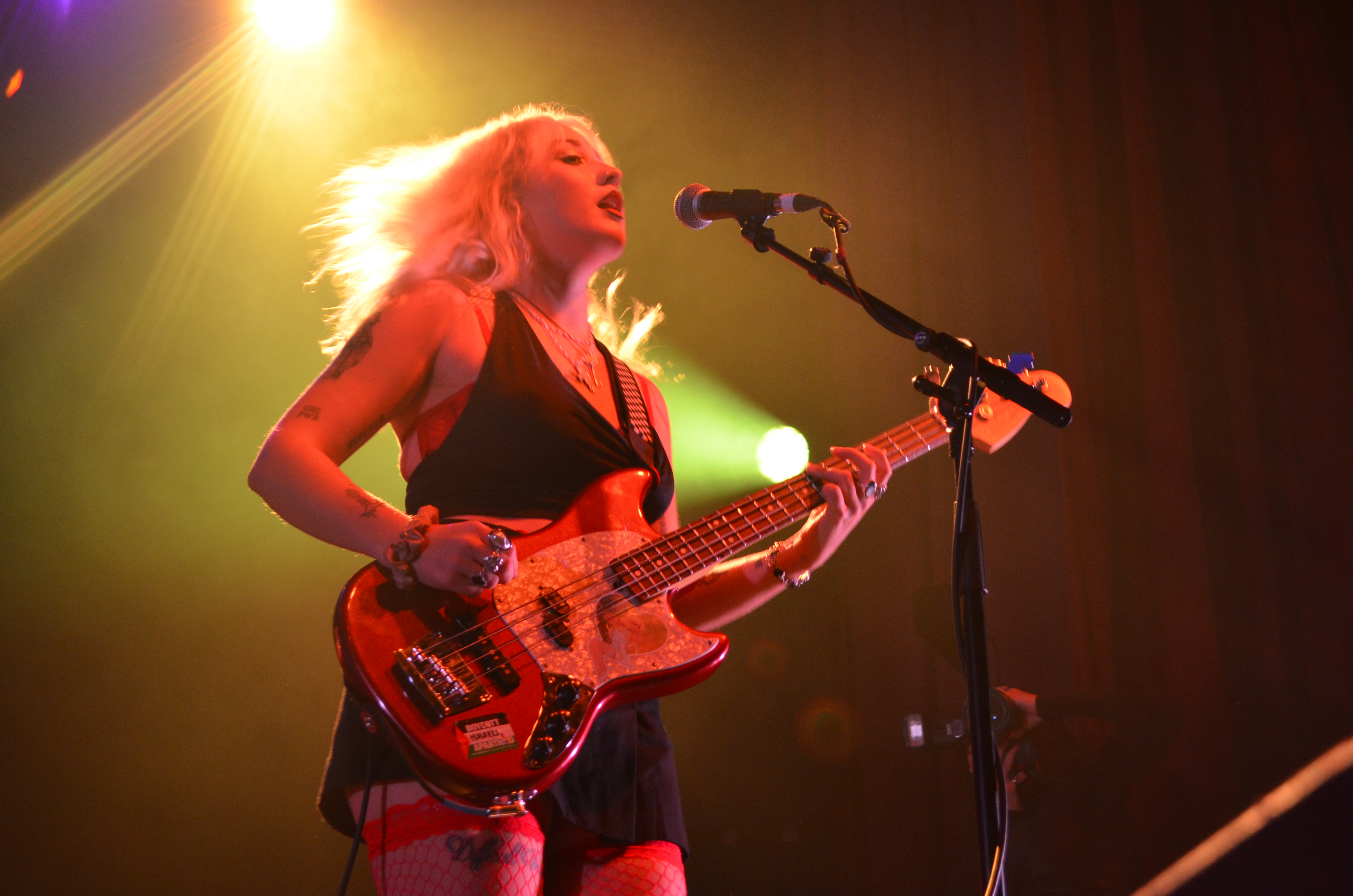
In many ways, the Lambrini Girls, evoking a mix of guitar-led aggression, pop rhythms and mocking lyricism, have forcefully carved out their space in a crucial new wave of British punk sound.
The Brighton duo, currently comprised of the magnetic frontwoman Phoebe Lunny and Selina Macieira-Boşgelmez, rose to prominence over the last two years with unapologetic anthems challenging social injustices. While the band’s structure saw a pivotal shift after 2019, it was the moment Lunny stepped into the frontwoman position, solidifying the band with Selina in 2021, that set the stage for their current political trajectory.
When a new musical blueprint brought over by by bands like The Ramones, then moulded by acts like The Sex Pistols and The Clash, we were introduced to punk music – a catalyst of social commentary fuel for anarchist, anti-monarchy protests. Yet, as the genre evolved into post-punk, hardcore, and pop-punk, its core mission remained constant: to challenge and confront social tension. Now, punk has been reclaimed by a new wave of marginalised voices, focusing on women, queer artists like the Nova Twins or ARXX.
It seems as the UK’s commentary becomes more polarised, the Lambrini Girls have managed to excel, turning generalised rage into targeted critique on UK powerhouses from the government to the police force. Their lyrics tackle modern feminist and queer issues, from sexual assault and toxic masculinity (seen in songs like ‘Cuntology 101’ and ‘Big Dick Energy’) to anti-trans bigotry and institutional failure, fusing aggression with surprising vulnerability. Their sound is confrontational, acting as an essential antidote to traditional rock expectations.
Seeing the Lambrini Girls live only further cemented my understanding of their mission. While many groups include social commentary, the Lambrini Girls take it a step further: they insist on active, immediate change. This is evident in their continuous back-and-forth, from stirring up rallying cries against political parties in songs like “Craig David” to celebrating queer legends in “Help Me I’m Gay” and embedding safety protocols into their mosh pits. Furthermore, the practice of having Selina read statistics on sexual assault convictions during every concert confirms they are actively leveraging their platform to evoke tangible social change, rather than just performing about it.
By utilising their platform, with their defiant political stands and their uncompromising live shows, the Lambrini Girls are not merely participating in the punk movement; they are defining its necessary evolution. They prove that punk rock today is still fast, loud, and angry, but the volume is now turned up on intersectional voices using 21st-century tools to broadcast a clear, powerful demand for social change.


Article & Photos by Jess Blissitt for Musik Magazine 2025


